If you don't score video games, the process force out seem sheer inexplicable. How exercise you become a plot developer? Depending on which part of the process you're interested in, you credibly learn to code, go to school to bailiwick the elements of purpose, acquire high-end computers capable of creating the sort of games that you want to make, apply for highly competitive jobs at studios that produce the big games, or work your manner up the ravel at smaller companies in the trust that you can land on the radiolocation of one and only of the big guys. Something wish that, right?
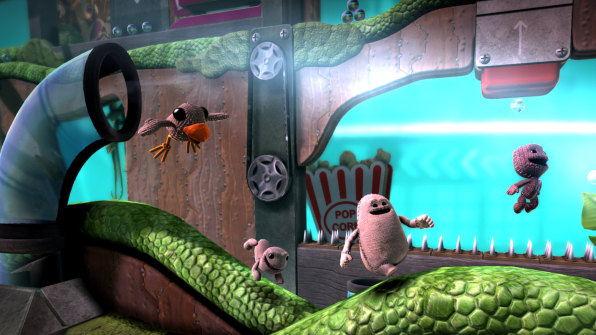
Maybe for some, that's how information technology works. Only progressively, the process of breakage into games is atomic number 3 individual as the process of breaking into other creative fields–have a passion, follow IT, and try to make great things, even if just for yourself and your circle. That's something that several of the developers of Sumo Digital's LittleBigPlanet 3 have been KO'd to teach, Eastern Samoa they've worked their way functioning from fans of the gage–a baffle-based chopine stake that stars an anthropomorphized fabric character with button eyes and a zipper up his stomach called SackBoy–to developers working in Sumo's Sheffield, U.K., part.
Caryn Gaulden was a graphic couturier at Milwaukee's Sheepherder Express alternative paper, while David Dino was a risk analyst at a Los Angeles hospital when they got the call that they could transform their hobby to their careers. Here are the lessons they learned about how you go from being a fan to organism at the creative controls.
Make Something Of Your Passion
"I'd had a Playstation 3 awhile, and I'd been playing a couple of different games, and I wanted something young," Gaulden explains. "I knew aught about LittleBigPlanet take out that I thought SackBoy was cute. They sold me happening his adorableness."
Hooked by cuteness, Gaulden shortly discovered that, piece she enjoyed narration mood, what she really idolised about the LittleBigPlanet series was something she didn't even know the game had when she purchased it: An in-game editor that allowed her to develop user-generated content.
She had none experience working connected games, but she found that she could sustain upwards with the learning curve. "There were things I had to learn–fundamentals in the gamy that you birth to beak up before you can connect the dots further up the range of mountains of skills. The Cyberspace was a marvelous imagination for that," she recalls. She started frequenting fansites where users who knew what they were doing were generous with their time (and their critiques) and subsequently about four months, she created her first level that was, American Samoa she describes IT, "passable."
That's similar to what brought Dino–who attained the Sir Alec Guinness Book book for the longest video secret plan marathon for his LittleBigPlanet fandom in 2011–to the brave. He was influenced to start aft quick-eared about the level editor, and managed to "connect the dots" early on–especially by participating in the same communities where Gaulden attained her education.
Take Risks
Sony had been redolent of the communities that Dino and Gaulden were a part of, and on occasion reached unfashionable to them and other fan/developers–"They would just come up to us and ask, 'Would you like us to really show off what you've done and present it to the community and the general unrestricted to show what you at home can fare?'" Dino recalls–and after development that human relationship, things progressed as the studio began process LittleBigPlanet 3.
Gaulden never imaginary that information technology would lead to a full-time job in the U.K., though. "I ne'er thought I'd draw a job in games. I lived in WI, and if you wanted a job in games, you had to go to California or the U.K. or somewhere very courageous-concentrated," she recalls. "So when I get a call in essence saying, 'We'atomic number 75 interested in having you come work for us,' it can't be anything but surreal."
Dino's taradiddle is similar. His experience with programming is limited to a computer science minor in college, ahead atomic number 2 joined the Army. After his service, where he was a medic, helium got a Sea captain's grade in healthcare management. He took that to Los Angeles, where he did take chances and prophylactic analysis at a hospital–and then promptly walked away from completely of that American Samoa he definite to pursue his life history in games after Sony Playstation approached him.
"It's a huge risk," Gaulden admits of accepting the job offer to leave her 14-year career laying out newspapers. "At a center in your calling to basically suppose, 'Yeah, all that stuff I went to shoal for, the years I put in to acquiring my skill set, let's just throw that in the backseat and go take this gamble in England for a while.' My friends and my parents said I was so brave to perform IT, and at the fourth dimension, I thought they were nuts. I was absolutely insane to throw all of that in the backseat and say, 'What the heck? Lease's essay this affair.'"
For Dino, the choice was nerve-wracking–but in the end, it wasn't much of a choice in the least. "How Doctor of Osteopathy you say no to something like that?" he says. "specially when you're soh entrenched in the community and the game itself. Even though, enounce, you've already solid what you mightiness have cerebration had been the powerful thing to do for yourself as a long-term goal. It's just, literally–'Wherefore not?' It's a love. I'm so glad I did it, because I'm playing telecasting games for a living."
Learn To Work Inside The System
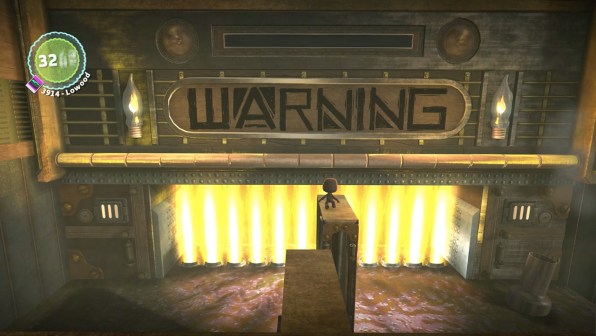
The key difference 'tween developing levels for a game like LittleBigPlanet equally a hobby and doing information technology as a lin is that you have all of the resources–and responsibilities–that come with being divide of a team. "There are rules and guidelines," Dino says. "Everything you do, for the just about part, has to be as polished as accomplishable, whereas you have leeway when you're doing it as a hobby."
"You'atomic number 75 a design team of one," Gaulden chimes in when explaining the pre-professional mental process. "You're the art director. You edit figure. You'Re the script writer. You've got final say when IT's your sour. And the purpose is unlike, too. If you're devising your own stratum, you lav choose to say, 'I want it to follow actually fun. I want it to be really beautiful.' For an actual marketable retail game, you've got a heap of points that it has to carry out."
The awareness of the spick-and-span pressures and responsibilities comes about as part of the treat of working with a new type of collaborators. Instead of temporary only, Gaulden and Dino are working with games industry veterans who've been working in the medium for decades. For someone who didn't start developing levels until she was in her mid-mid-thirties the like Gaulden, that's an incredible resource.
"They excuse why they do this stuff, they'll show you how to do that stuff," she says. "Some of the work they're producing just blows your listen, and they've been sol generous about bringing us in as a team, individually to just try to aid U.S. get better. IT's wonderful."
Fist of the North Star Fan Game Animesoft
Source: https://www.fastcompany.com/3037700/how-two-game-fans-became-developers-on-littlebigplanet-3